The Funky Buckler
  • Home
  • Blogs
  • About the Author
  • VBHF
  • FAR
  • Donate
  • Home
  • Blogs
  • About the Author
  • VBHF
  • FAR
  • Donate

Making a Historical Buckler

3/24/2023

0 Comments

 
Bucklers and their material can impact certain aspects of the modern HEMA fight. For example, plastic bucklers make similar sounds to hard plastic gear when struck, resulting in fencers sometimes thinking that they have hit their opponent when they have not. In addition, metal bucklers result in the blade bouncing off of them as opposed to wood bucklers which sponge the impact more. But are there more factors that can come from medieval bucklers that we do not see with modern constructions?

In this series of projects, I and one of my students will be creating bucklers loosely based on examples found in The Book of the Buckler by Herbert Schmidt. 

The primary requirements we have for the bucklers is the following:
  • The buckler shall use historical examples for its design.
  • The buckler shall withstand at least three rounds of sparring involving heavy messer strikes as well as at least two other sparring matches to prove initial durability.
  • The buckler shall survive 12 classes involving up to an hour of drills and up to an hour of sparring.

Rationale for the Initial Durability Test

The durability test was designed to test immediate failures in the buckler design before continuing to the longevity testing. Based on experience, messers in modern HEMA sword and buckler tournaments appear to deliver the hardest hits so being able to withstand blows from those swords seems pertinent to testing the design. Furthermore, two other sparring matches will be conducted to add a variety of hits to the buckler to try and create an early failure.

Rationale for the Longevity Testing

As a cleric who may study I.33 and expect to use their skills for defense in duels or self-defense, it seems reasonable to assume that their buckler should be able to be trained with as well as assist in their defense to get them from one town to the other and then home again. After all, bucklers were considered military equipment in the Saxon Mirror so it was a bit of an investment. It likely would not have been acceptable for their bucklers to be replaced once a month just due to use during training.

Because of this, we set the success criteria for our bucklers to be able to last for at least a month in our regular HEMA practice routines, 12 practices including drilling and sparring. If our bucklers can last for the full month, they will be deemed acceptable from a longevity perspective.

To assist in this success criteria, we are allowed to do minor repairs to our bucklers including re-tacking the lining, adding wood glue, re-hammering nails, and other simple repairs we feel we (or a professional) could have done for us in the early 14th century.

Unfortunately, success criteria of 12 practices is a bit of a shot in the dark. I would love to find better historical examples of expectations of the life of a buckler to better refine this requirement we laid out for this project.

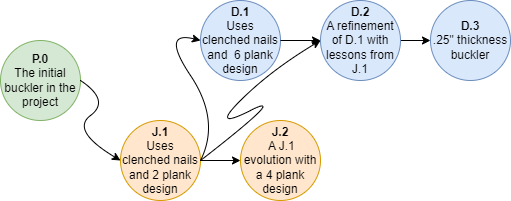
Summary of the Project So Far

Picture
P.0 Buckler: Failed Durability Testing
J.1 Buckler: Completed all testing successfully
D.1 Buckler: Completed all testing successfully
J.2 Buckler: Completed all testing successfully
D.2 Buckler: Completed all testing successfully
​D.3 Buckler: Completed all testing successfully

Total Weight of the Bucklers

While the weight of the buckler is not a primary requirement, the bucklers must be usable for drilling and sparring. Because of this, the weight must be taken into consideration.

Below is the current weight of our created bucklers compared to purchased bucklers:
  1. 14" J.1 Buckler: 1920 gr
  2. 12" J.1 Buckler (Calculated.): 1645 gr
  3. Steel 14 ga Buckler: 1383 gr
  4. D.1 Buckler: 1337 gr
  5. P.0 Buckler: 1323 gr
  6. J.2 Buckler: 1286 gr
  7. D.2 Buckler: 1243 gr
  8. Fluted 16 ga Buckler: 1177 gr
  9. Leather Buckler: 1076 gr
  10. D.3 Buckler: 981 gr
  11. Store-Bought Wood Buckler (No Wrap): 962 gr

Project Wrap-up and Conclusions

This project has been enlightening for me on the ruggedness of historical bucklers. The primary hypothesis that bucklers were not throw-away shields only intended for a few exchanges seems plausible. After the first buckler, all the project bucklers (and the ones Jerod and I made for fun for ourselves and others) have proven durable and long-lasting. In the context of I.33, it would seem that the contemporary practitioners of the system likely used the same buckler for an extended period of time. 

One exception to the longevity of bucklers and the testing we did is regarding sharp blades and different types of weapons, like axes, that are more designed to split wood than a sword. Several examples in The Book of the Buckler show re-used boards and ad-hoc buckle repairs. While the liner and planks may be split, these sections could be patched and replaced, allowing for more use out of the original buckler. More importantly, as long as the buckler allows you to survive until your subsequent encounter, it has done its job. Even if we do not spar and practice with sharps, the high volume of impacts and hard hits the bucklers have withstood has convinced me that with disciplined Medieval craftsmanship, the buckler could be a lifelong investment for medieval fencers of the 14th century.

More Information on Each Buckler

P.0 Buckler
​J.1 Buckler
D.1 Buckler
J.2 Buckler
D.2 Buckler
​D.3 Buckler

Additional Analysis on Buckler Construction

The Importance of Buckler Liners

0 Comments


Leave a Reply.

    Categories

    All
    Armor Related
    Book Reviews
    General History
    I.33 Related
    Interviews
    Practicing HEMA
    Product Reviews
    Research Projects

    Picture
    Picture
    Picture
Proudly powered by Weebly