The Funky Buckler
  • Home
  • Blogs
  • About the Author
  • VBHF
  • FAR
  • Donate
  • Home
  • Blogs
  • About the Author
  • VBHF
  • FAR
  • Donate

D.3: The Thin Buckler

10/28/2023

0 Comments

 
​With the construction methods of the buckler project showing consistent durability, it is now time to push the envelope. The D.3 buckler was designed to reduce overall weight by reducing the thickness of the buckler from .5” to .25”. A better rawhide liner will also be used for this buckler to improve impact resistance over the rawhide bones that were used in previous D bucklers for the project. 

Most of this post was written prior to the buckler failure. The second half of this post (indicated by the part 2 in the title section) begins the post-break research portion of the D.3 Buckler.

Construction

Throughout the construction, parts of the buckler were measured to understand better where the weight came from. The results of these measurements are shown at the end of this section.
​
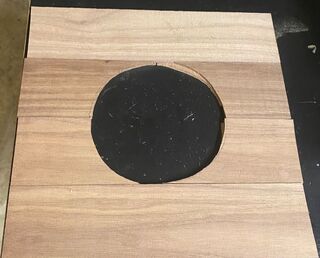
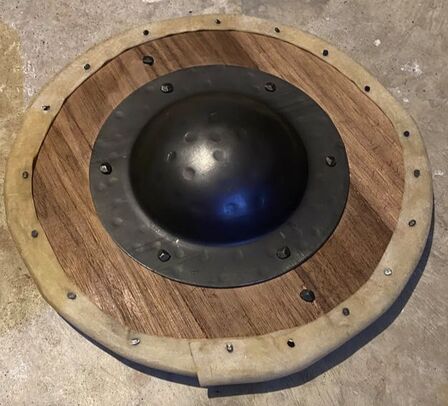
This buckler followed a similar construction method as the previous bucklers. First, the planks were cut and then overlayed to make the face of the buckler. Walnut boards were used for this buckler mainly because it was available in .25” thickness. 
Picture
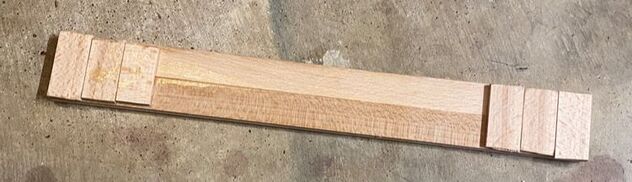
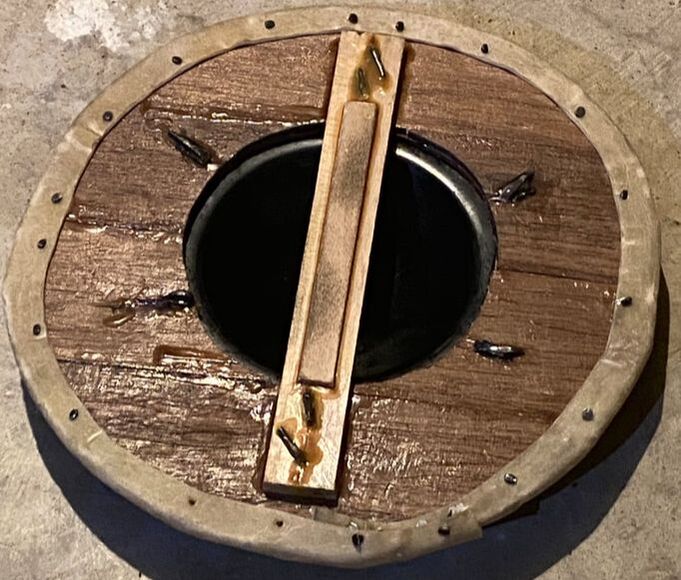
​Little project wood boards were used to create a handle solution for this buckler. Layers of the little boards were overlayed to add some amount of structure. The little pieces were then glued together and allowed to cure before attaching to the face of the buckler.
Picture
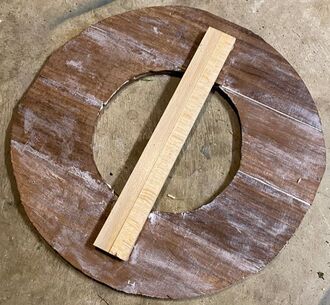
​Once the handle was glued together, it was then glued to the buckler face boards.
Picture
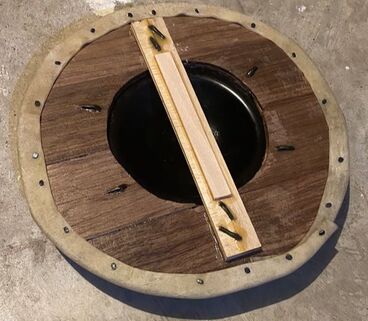
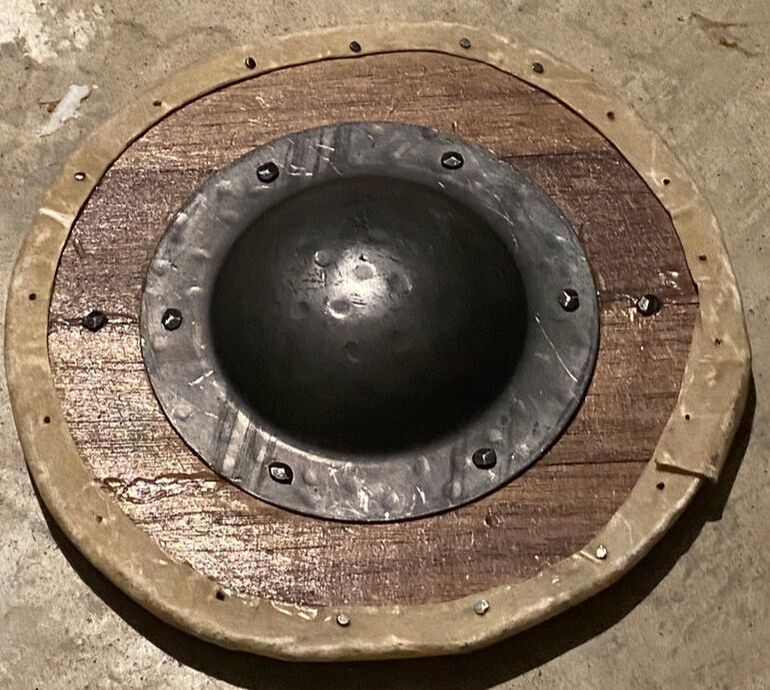
​Next, the boss and liner were attached to the wooden structure like prior buckler constructions for this project. The rawhide was soaked and then fitted around the edge of the buckler and tacked down. Clenched nails were used to secure the boss in place. 
Picture
​The buckler was then covered in a layer of wood glue to provide resiliency. This was a change done for this buckler because prior constructions oiled the wood.
Picture
Once the liner had dried, the buckler was weighed.
Wood body: 266 gr
Handle 45: gr
Boss: 523 gr
Without liner weight: 860 gr
Final weight: 981 gr

Durability Testing

The buckler withstood sparring against a messer, a longsword, and another sword and buckler. Similar to previous bucklers, this buckler took the hardest hits by the messer, and while some of the nails came loose, the clenching prevented the nails from being freed.

​Longevity Testing

This buckler has been my buckler for nearly 3 months (roughly 30 classes) with very little damage. The nails on the boss had to be replaced due to impact on the boss, but even when the bucker was down to two nails, the boss stayed in place and lived to make it to the end of a practice when repairs could be done.

Tacks for the liner have come off, but the hardness of the liner has secured it in place. Near month 2, the overlapping section of the liner was pulled up while sparring. The liner was not destroyed and later glued back down to secure it.
​
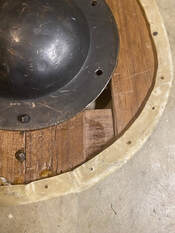
Interestingly, wood under the liner has been chipped away. Instead of cracking a board, these chips have just slowly been whittled away with time. This seems to be a testament to the quality of the liner and how a good liner can make a difference in the survivability of a buckler.
Picture
Picture

​Observations

I am stunned that the lego-brick style handle has survived but I believe that shows how much impact force the rest of the buckler mitigates. The light weight of the buckler also allows for good positioning in the later parts of a sparring match when fatigue is setting in.

Failure (Beginning of Part 2)

After just over 4 months, the buckler suffered a major failure. A plank cracked near the top of the buckler. This is the section where most of the impact force from descending cuts was received on the buckler. After the sparring match when this occurred, the top section felt loose which seemed to indicate both layers of the planks had been compromised.

After the crack occurred, I sparred with the buckler one more time (first to 10 points) to see if the failure would prevent the buckler from being able to complete the match. To my surprise, the buckler was able to finish the sparring match. I believe this is a testament to how much work the rawhide liner does at cushioning impact force on the wood itself. However, even though the buckler successfully did its job, sections of the plank where the crack occurred had clearly broken loose and were only held in place by the liner.

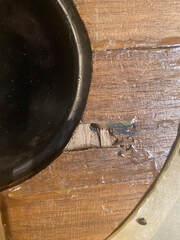
The loose pieces were removed to inspect the damage.
Picture
Picture
Picture
As I had suspected during sparring, both layers of the planks were broken, which compromised the structure. Interestingly, the nail on the opposite side of the buckler from the broken planks was torn off and the wood cracked. This could have been unrelated or the boss transferring impact force differently.

Could the buckler still perform? Maybe if I changed which side was on top. However, at this point the buckler was fighting for its life. It was time to retire it from this research project. Or was it?

Field Repair Test

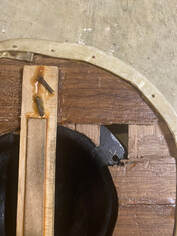
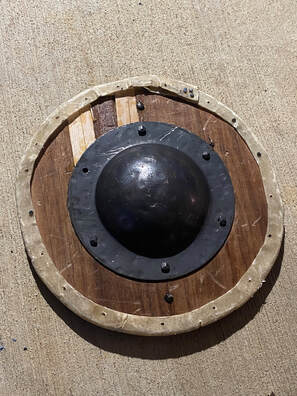
Some of the bucklers in The Book of the Buckler feature what appears to be reused wood from other bucklers. A rough field patch may be sufficient to get more life out of the buckler. In the spirit of reusing wood that I already had lying around, the broken-off pieces and the lego-brick style would be used for the handle would be used for repair.

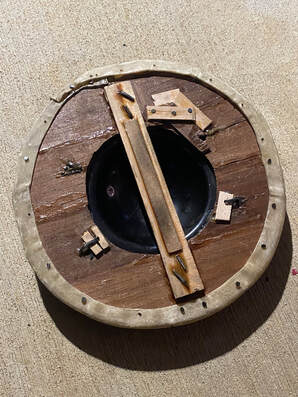
I started with patching the broken areas with smaller wood planks that I could shape to fill the broken areas. Next, some of the broken wood and more of the smaller plank were applied to the back of the buckler to provide some structural support to the broken section. This was done if more cracking had occurred that was not identified. Finally, new planks were placed where the nails go since the planks in those areas had been worn and could use more friction to hold the nails in place.
Picture
Picture
The repair was only put through durability testing due to the more compromised state of the buckler as a whole. The repairs were able to survive multiple rounds of sparring without issues. The small plank in the bottom left of the back-view was split during construction and not during sparring.

However, while the bucker was able to perform, there was still some looseness in the section that had failed. This was likely due to the broken sections warping and not aligning as well as initially, even with the structural boards added.

Ultimately, while the repair "worked", it seems more likely that the good planks would be preserved while the overall wooden structure would be remade while still re-using the boss, liner, and possibly the handle.
0 Comments


Leave a Reply.

    Categories

    All
    Armor Related
    Book Reviews
    General History
    I.33 Related
    Interviews
    Practicing HEMA
    Product Reviews
    Research Projects

    Picture
    Picture
    Picture
Proudly powered by Weebly