|
When studying Historical European Martial Arts, there will come a time when you will be told to “watch your edge alignment” or that “your hit was flat”. People may even go as far to point out that your sword is not a lightsaber and cannot just cut through things on contact. But why is this such an important concept when learning swordsmanship? Today, we will be exploring how attacking targets with sharp swords can improve your technique and also help your interpretation of a given system. Just to be clear, this is an exploration of using swords against targets such as tatami mats and water bottles, not friends. Do not use sharp swords against other people. I consider myself a novice when it comes to cutting with sharp swords. At best, I am a backyard amateur. However, there are incredibly smart and well-practiced individuals willing to help you get started with sharp swords. Brittany of Mordhau Historical Combat, a well-accomplished competitive sharp sword wielder, recommended Michael Edelson’s Cutting with the Medieval Sword. While the book primarily focuses on longswords, the general advice and science behind cutting with a sword is applicable to all bladed weapons. This was a great starting point for me and helped me focus on the technique that mattered. Another helpful resource was the Sword Buyer’s Guide, which helped me with the dos and don’ts of buying swords online. Safety WarningWielding a sharp sword requires utmost caution and respect for the weapon's potential danger. Before engaging in any practice or demonstration, ensure you have received proper training from a qualified instructor. Always handle the sword with care, keeping it pointed away from yourself and others. When practicing strikes or maneuvers, maintain a clear and controlled environment, free from obstacles or bystanders. Never perform techniques beyond your skill level or attempt reckless stunts. Inspect the sword regularly for any signs of damage or wear, and never use a blade that is compromised in any way. Remember, the sharpness of the sword demands the utmost respect and responsibility. Failure to adhere to safety precautions may result in serious injury or harm. Swordplay is a disciplined art, and safety should always be your top priority. Learning How Swords WorkSharps swords can be useful tools to teach fencers the why behind emphasized-technique in HEMA, such as edge-alignment. Swords are designed to cut and thrust and are agile weapons. However, for the sword to be fully utilized, form and technique must be factored in. Edge alignment, blade motion, body mechanics all become highlighted when trying to attack a target with a sharp sword. In HEMA, the term “baseball swinging” gets thrown around when a fencer drops their shoulder and swings the sword like a baseball bat. While this can generate a lot of force, the truth is that swords do not have the mass distribution for this attack to effectively cut. Using a sharp sword on a target will quickly highlight the issue with these types of swings as the target receives minimal damage. Improving InterpretationAnother advantageous use of sharp swords is the improvement in interpretation. When interpreting systems, it is always important to ask if a technique is functioning as we expect. Using sharp swords and targets can help instructors visualize the lethality of a technique when it is performed. It also can help instructors understand what attacks are a threat instead of more incidental strikes. One of the better examples is when a sword is deflected low and is brought to make contact using a short distance to contact the opponent’s leg. Because the original attack lost its power and the structure is broken, the attack to the leg (depending on distance traveled and other factors) may not be effective. These are the types of actions that can be explored with sharp swords. With that in mind, let’s look at a few attacks in I.33 with a sharp sword! Other I.33 scholars have also joined in on the use of sharps to improve technique. Aegis Historical Combat did a great short clip on Instagram highlighting the effectiveness of the sturtzhau from halfshield. Closing ThoughtsImproving technique and interpretation are ultimately the second and third reasons to attack targets with sharp swords. The number one reason is because it is fun. Swords are unique weapons, and we all realize how fun they are (otherwise, you likely would not be reading this blog today). So, let’s close out by watching videos highlighting experienced swordsmen cutting targets with arming swords!
0 Comments
Today, we will discuss one of my favorite flow drills to get fencers used to moving with a sword and buckler. The techniques in I.33 require quite a bit of fluidity in bringing the sword and buckler together. This can be overwhelming for new fencers, so this is a valuable drill for building flow and comfort with the weapon set. Details of the DrillThis drill is based on the British military sabre drills from Henry Angelo. This drill starts with the fencer in the second ward. From there, deliver a cut from your shoulder to your knee on the opposite side and end in the first ward. Next, deliver a cut from the buckler side shoulder to the opposite knee. This is done by extending the buckler arm forward with the thumb down to move the elbow out of the way of the sword. End this cut into the fifth ward. Now, cut up above the buckler and end in the third ward. Next, perform another rising cut above the buckler and end in the second ward. Now, deliver a horizontal cut under the buckler and end in the first ward. Then, deliver a horizontal cut back under the buckler and into the second ward. Finally, deliver a vertical cut above the head and bring it towards the buckler. Then, recover into the second ward. 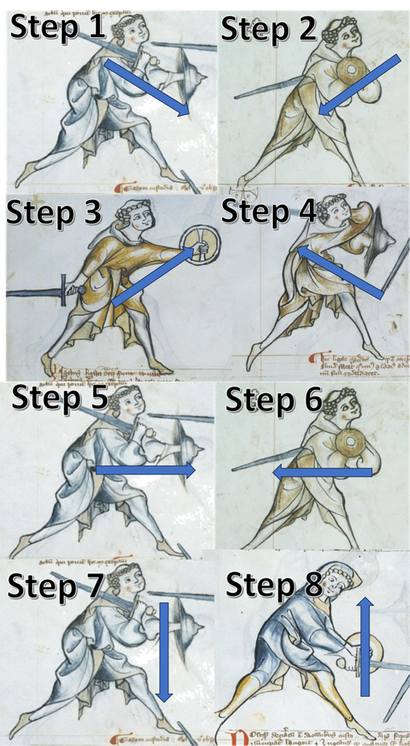 The intent of this drill is to help a fencer get comfortable with using the sword and buckler as a weapon pair. Be sure to emphasize bringing the sword and buckler together and positioning the buckler to defend the hand along the path of the cut. When doing this drill, it is important to practice retracting the buckler during the cut and to keep the sword hand either at or behind it, ensuring the safety of the sword hand. Variations of the DrillThe drill can also be modified in several ways. One modification is to step with each cut. This adds the practice of using footwork while focusing on sword and buckler placement. I commonly drill this by stepping forward with the first action and then stepping back with the next. This helps the fencer practice not narrowing their stance when performing sword actions. Another variation involves using the paths of the cut described but not fully ending in the ward. This can be beneficial to practice quicker elbow or wrist cuts while in a bind. However, while this drill is faster, it also can be sloppier without the fencer having an end ward for each action. To combat this, focus on transitioning naturally into the next action while ensuring the sword and buckler are close, and the sword hand stays behind the buckler. The third modification (and certainly not the last) is to change what cuts are performed. For example, only the third and fourth actions with the rising cuts could be performed if the fencer would prefer to practice those cuts. Alternately, thrusts could be mixed instead of cuts to practice transitioning thrusts and cuts while keeping the sword and buckler together. The Meyer’s Cross can also be used for different variations on this drill. 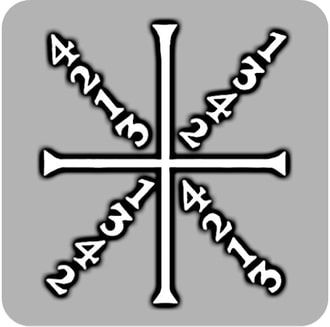 Closing ThoughtsThis drill is a fantastic drill for sword and buckler fencers at all levels. Sword and buckler, especially I.33, relies heavily on the fencer feeling comfortable with using the weapon set together. By practicing these flow drills, fencers can build the muscle memory and discipline needed to fence effectively with this weapon combo.
Studying treatises is not the only way competitors prepare for HEMA tournaments. Some competitors prefer to focus on being more athletic than their opponents while others may enjoy discovering how to use a sword on their own. These competitors do not necessarily use the conventional techniques found in treatises. These type of competitors in tournaments highlight the drawbacks and limitations that can occur when studying treatises to learn swordsmanship. Today we will be exploring the disadvantages of studying treatises to prepare for HEMA tournaments. The Treatises (Or the Interpretation) Could Be WrongSometimes studying treatises (and especially when studying modern interpretations of them), can teach a fencer bad techniques. When studying history, it is a common practice to not discredit or disagree with statements made by a primary source. However, when interpreting the validity of a historical martial art, it can be useful to question the techniques presented in these sources. Not all treatises are created equal and some may exist without the author truly having a martial background. For more on the discussion of errors in sources, see the following discussion by Matt Easton: It is also important to remember that the treatises studied in HEMA were written by people, translated by other people, and interpreted by a different set of people. Techniques could be lost in translation that unfortunately can lead the general HEMA community to the wrong conclusions when attempting to recreate these systems. For some sources, such as the Lichtenauer lineage of treatises, it is easier to cross-reference the source with other sources interpreting the same technique. This allows for a higher degree of confidence for the interpretation of the techniques. However, this is not a luxury for other popular treatises such as I.33. For sources like I.33, a number of secondary interpretations are used to cross-reference and discover the true intent of I.33. This can lead to a higher risk of misinterpretation based on false-assumptions. The Treatises Can Be Limiting The mindset of only doing the techniques a manuscript includes can lead to disadvantages in HEMA tournaments. Sometimes students feel that if a technique is not included in the treatise they study, they cannot do it. One example of this is sabre fencers who do not use hanging guard because it is not taught in their system. However, there is a difference between not doing a technique because the fencer is not familiar with it and not doing a technique because it is not in the sources they study. It is important to remember that no one can include everything in their writing, even the authors of fencing systems. For example, I.33 does not include a technique on striking someone in the face with a buckler nor does it include a technique on how to prevent this. However, Paulus Kal’s treatise on sword and buckler does include this technique. If a fencer rigidly applies I.33 against other sword and buckler fencers, they will be vulnerable to buckler strikes while also limiting themselves to not delivering buckler strikes to the opponent’s face. 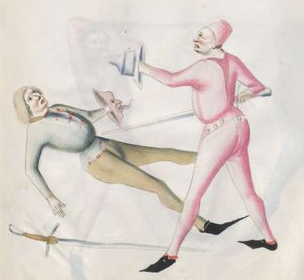 The Buckler Strike to the Face in Paulus Kal's Sword and Buckler Images Our Implementation of the Treatises Could be Wrong A number of variables can dramatically impact the validity of certain techniques taught in treatises. The sources studied in HEMA come with their own historical context for implementation. If a competitor in a HEMA tournament attempts to use the unarmored combat techniques of longsword when fighting in armor, they will not succeed. Without recognizing the potential variability in a fight, a fencer may improperly use a technique and end up on the losing side of a tournament. In HEMA tournaments, fencers are required to wear a certain amount of safety equipment. This equipment such as heavy protective gloves and HEMA fencing jackets can change how effective a technique in a treatise can be by limiting the mobility the fencer. Another variable that can impact technique is different heights between fencers. Differentials in heights create new angles of attacks a fencer must deal with and also can change what technique is required to defend against a certain action. Closing Thoughts The goal in HEMA tournaments is to hit your opponent without getting hit. This creates a fair amount of flexibility in what techniques will be used.
One of the best attributes a competitor in a HEMA tournament can have is adaptability. It is important to remember that there are many different types of fencers who will use the techniques they feel are best suited for themselves. Sometimes, those techniques are less effective than your own. Other times, your opponent will have the advantage and you will need to adapt to defeat them. Studying fencing treatises does not necessarily encourage adaptability. Fencers may assume that the treatises are infallible, or that all scenarios are covered in the treatise, or that the techniques are not impacted by gear. These are just some of the ways treatises can limit fencers. It is important to remember that the manuscripts are meant to be guides for the use of the weapons they teach. If left to just theory, these treatises can fall short in practice. It is the responsibility of the fencers to adapt the treatises to what suits them and to hit their opponent without getting hit themselves. |